The Rabbi Who Found Messiah: The Story of Yitzhak Kaduri and His Prophecies of the Endtime.In fall 2005, at 108 years old, Rabbi Yitzchak Kaduri, the most venerated rabbinical Jewish leader in Israel, claimed that he had personally seen the Messiah in a vision and knew both His name and when he would appear publicly. Kaduri wrote the name of the Messiah in a sealed message with instructions that it be locked away until one year after his death. And he declared that a particular famous world leader had to die before the Messiah would return. A few months later the famous world leader fell gravely ill. The religious and political world held its collective breath. Within weeks of the world leader s malady, the elderly Rabbi Kaduri died. Several hundred thousand people flooded the streets of Jerusalem for his funeral, one of the largest in Israel s history. The death message, secreted away for one year as instructed, was finally opened and deciphered. There, before the eyes of the world, was the name of the soon-coming Messiah according to this celebrated teacher of Israel. Did the elderly, revered rabbi actually have a vision from God? Did he really see the Messiah who is soon to come? Based on the book by the same name This WND Films documentary The Rabbi Who Found Messiah by Carl Gallups takes an close look at the events surrounding Rabbi Kaduri s vision and prediction and explains what it all means. Renowned messianic rabbi and New York Times bestselling author Jonathan Cahn and Pastor Gallups provide insight into the messianic Jewish perspective, Hebrew messianic expectations, and the profound nature of Rabbi Kaduri s amazing pronouncement. The note that shook the religious world to its foundations is still shaking the world today. The pieces are yet falling into place just as the old rabbi predicted!
Maand: augustus 2017
Bankpasjes hebben niet alleen een betaalchip, maar ook -geheel overbodig- stiekem RFID
Bevestigd: paus Franciscus heeft commissie aangesteld om Humanae Vitae te “herinterpreteren” in het “licht van Amoris Laetitia”
Roberto de Mattei schrijft: “Het zal aan Mgr. Gilfredo Marengo zijn, professor aan het Johannes Paulus II-instituut, coördinator van de commissie, benoemd door paus Franciscus om de encycliek Humanae Vitae door Paulus VI te “herinterpreteren”, ter gelegenheid van de 50ste verjaardag van de uitgave ervan, die volgend jaar valt. De initiële geruchten van het bestaan van deze commissie, die nog geheim is, en bericht door de Vaticaanse verslaggever Marco Tosatti, waren van een betrouwbare bron.”
De Mattei bevestigt nu zelf het bestaan van deze commissie: “We kunnen bevestigen dat er een commissie bestaat, bestaande uit Mgr. Pierangelo Sequeri, hoofd van het Johannes Paulus II Pauselijk Instiuut, Professor Philippe Chenaux, docent Kerkgeschiedenis aan de Lateraanse Pauselijke Universiteit en Mgr. Angel Maffeis, hoofd van het Paulus VI instituut in Brescia. De coördinator is Mgr. Gilfredo Marengo, Docent in Theologische Anthropologie aan het Johannes Paulus-II Instituut en lid van de Besturend Comité van het CVII-Centro Vaticano II Studi e ricerche.”
De Mattei zegt dat deze commissie die benoemd werd door Franciscus, de taak heeft om de Vaticaanse Archieven te doorzoeken en de documentatie boven te halen die verband heeft met het voorbereidend werk over Humanae Vitae, die plaatsvond over een periode van drie jaar, tijdens en na het Tweede Vaticaans Concilie. Johannes XXIII had in 1963 een eerste “studiegroep’”aan het werk gesteld, die onder Paulus VI tot 75 leden aangroeide. In 1966 leverden deze “experten” hun conclusie aan de Paus, waarbij ze suggereerden om “de deur te openen voor artificiële contraceptie.” Paus Paulus VI ging daar niet mee akkoord en besloot zelf actie te ondernemen.
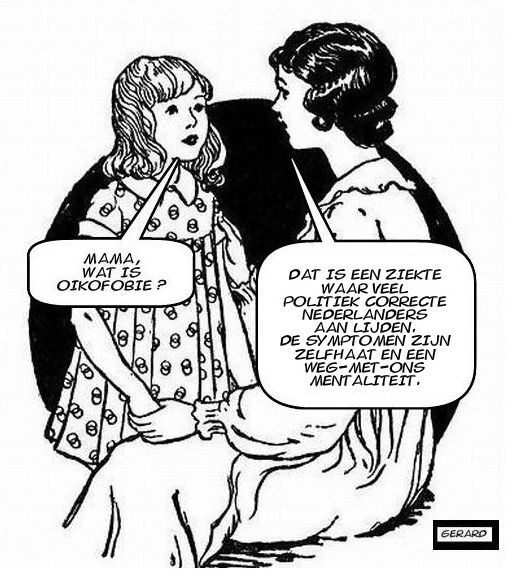
Oikofobie
Oikofobie is het tegenovergestelde van xenofobie (afkeer van het vreemde). Een Oikofoob heeft een ziekelijke afkeer van de eigen cultuur, de eigen gebruiken, de nationale identiteit en de eigen geschiedenis. Oikofobie manifesteert zich via multiculturalisme en het enthousiasme voor immigratie (opengrenzenbeleid), waarbij zoveel mogelijk wordt aangepast aan de cultuur en religie van de ‘nieuwkomer’. Ook de Europese integratie (het verkwanselen van de soevereiniteit aan Brussel) valt onder Oikofobie.
Gerard