Dag: 12 januari 2018
Video: De evolutietheorie kan niet bewezen worden
 Evolutie is volgens de gangbare wetenschap de manier waarop al het leven op deze aarde is ontstaan. Maar is dat wel zo? Als je iets wetenschappelijk wilt aantonen wordt daarvoor de wetenschappelijke methode gehanteerd wat inhoudt dat iets waarneembaar, testbaar en dat de resultaten herhaalbaar zijn.
Nu daar ligt het grote probleem met de evolutie theorie, want die gaat er van uit dat een soort in een ander soort kan veranderen. En dit is nog nooit in een waarneembare tijd aangetoond. Het duurt miljoenen jaren en is daardoor dus nooit aantoonbaar.
We geloven dus dat de evolutie heeft plaatsgevonden, maar niemand heeft het ooit aan kunnen tonen, waarmee de Darwin evolutie een geloof is in plaats van wetenschap.
In de onderstaande video zie je dat zelfs studenten en professors niet 1 voorbeeld kunnen geven van een verandering van soort.
Toch vreemd dat een grote rondvraag op een universiteit over deze theorie geen enkel goed voorbeeld oplevert waarmee een eventuele evolutie kan worden aangetoond.
Dit geeft toch wel stof tot denken over wat ons altijd geleerd is, want het is misschien wel blind geloof in plaats van zeker weten.
The Fifty-Year Descent to Footnote 351: Our Progressive Desensitization to the Most Holy Eucharist
 Peter Kwasniewski, 10 jan. 2018.
We did not wake up one fine day in 2017 to find ourselves suddenly confronted with Eucharistic sacrilege being promoted from on high. There was a long, slow process that led to this moment. It consisted in the gradual dilution of the sacredness of the Holy Sacrifice of the Mass and of the Blessed Sacrament at its heart, with institutionally tolerated sacrilege along the way. Fifty years of desacralization has ended in the temerity of contradicting the entire Catholic tradition about the most holy of all the Church’s mysteries.
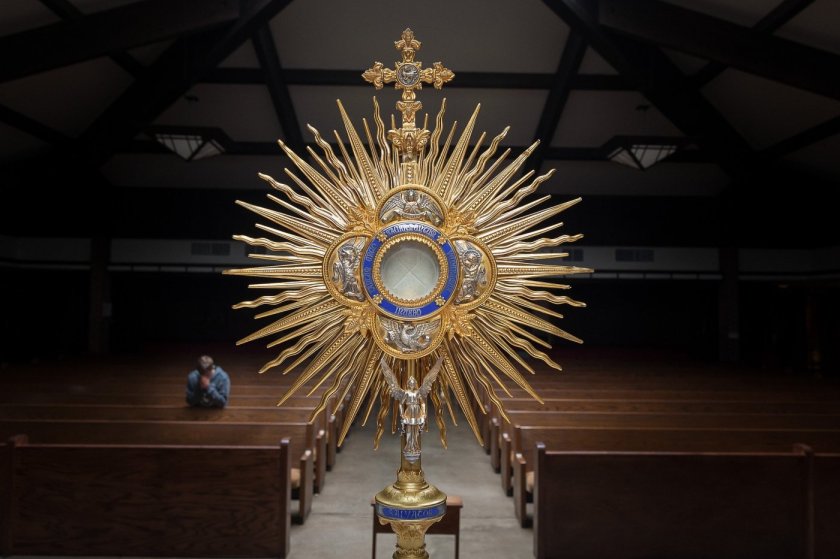
The first major step was the allowance of communion in the hand while standing—a sharp break from the deeply-ingrained practice of many centuries of kneeling in adoration at the altar rail and receiving on the tongue, like a baby bird being fed by its parent (as we see in countless medieval depictions of the pelican that has wounded her breast in order to feed her chicks). This change had the obvious effect of making people think the Holy Eucharist wasn’t so mysterious and holy after all. If you can just take it in your hand like ordinary food, it might as well be a potato chip distributed at a party.[1] The feeling of awe and reverence towards the Blessed Sacrament was systematically diminished and undermined through this modernist reintroduction of an ancient practice that had long since been discontinued by the Church in her pastoral wisdom. Nor, as has been well documented, did the faithful themselves request the abolition of the custom of receiving on the tongue while kneeling; it was imposed by the self-styled “experts.”[2]
The second major step was the allowance of lay ministers of communion. This reinforced the perception that the Church had given up all that stuff about the priest being essentially different from the laity, about the Mass as a divine sacrifice and the Eucharist as the Bread of Angels that only anointed hands are fit to handle. True, a priest still had to say the magic words, but after that, Jack and Jill could come up, take bowls and cups, and hand out the tokens of club membership.
The effect of these “reforms” and others like them (the replacement of majestic and mysterious Latin with everyday vernacular, the substitution of guitar and piano ditties for pipe organ and chant, the turning around of the priest to face the people like a talkshow host, the removal of altar rails, the decentering of tabernacles, the uglification of vestments and vessels, and more) was to weaken and corrupt the faith of the people in the Mass as a true and proper sacrifice and in the Eucharist as the true Body and Blood of Jesus. No wonder that after this, the idea of the Eucharistic fast, and of preparing oneself for communion by going to confession, went right out the window for the vast majority of people. The Church’s own pastors didn’t act as if they really believed these things anymore, so why should their flocks?
In short, we have lived through, and suffered under, half a century of ritual diminishment and symbolic contradiction of the Church’s faith in the sublime mysteries of the Body and Blood of Christ.
Now the Secret Commission Has a Face
 Luca Maria Negro, the president of the Federation of the Evangelical Churches in Italy has announced on nev.it (January 10) that “2018 will be a crucial year for ecumenism in Italy and in the world.”
As a reason for this, Negro says that this year a Tavolo permanente di consultazione (Permanent Board of Consultation) with Catholics, Protestants and Orthodox will be founded in Italy. Negro does not explain why this will be “crucial” for ecumenism worldwide.
Anonimi della Croce (January 11) fills in the gap. According to the blog the new board is the already existing secret commission that is working on an ecumenical mass. Its next meeting will be on February 12.
Bishop Ambrogio Spreafico of Frosinone, the responsible for ecumenism in the Bishops’ Conference, said according to agensir.it (December 11) that the basis for this new structure is that “nobody can say that he is the only possessor of the full truth”. This is, however, one of the essential claims of the Catholic Church.
According to Anonimi della Croce the group will launch an ecumenical mass within the next months.
> Now the Secret Commission Has a Face
Kliks op landen
5,4KVerenigde Staten451Canada430Verenigd Koninkrijk341India273Australië257Filipijnen160Duitsland156Nederland150
 De Argeloze Duif
Je moet ingelogd zijn om een reactie te plaatsen.