Italian Liturgist Alleged to be Working on Ecumenical Mass: “Transubstantiation is Not a Dogma”

Posted on October 28, 2017 by abyssum

notre_dame_paris

Italian Liturgist Alleged to be Working on Ecumenical Mass: “Transubstantiation is Not a Dogma”

Steve Skojec October 28, 2017.

In his Monday column at First Things, Italian journalist and veteran Vatican-watcher Marco Tosatti gave voice to what had previously been little more than a whispered rumor: that a group was at work, with Vatican knowledge and support, on a kind of interfaith liturgy:

[T]here is the matter of the “Ecumenical Mass,” a liturgy designed to unite Catholics and Protestants around the Holy Table. Though never officially announced, a committee reporting directly to Pope Francis has been working on this liturgy for some time. Certainly this topic is within the jurisdiction of the Congregation for Divine Worship, but Cardinal Sarah has not officially been informed of the committee’s existence. According to good sources, Sarah’s secretary, Arthur Roche—who holds positions opposite to those of Benedict XVI and Sarah—is involved, as is Piero Marini, the right-hand man of Monsignor Bugnini, author of such noted works as La Chiesa in Iran and Novus Ordo Missae.

Today, at his blog, Stilum Curae, Marco provides a bit more information on this story:

I cannot help recalling a comment sent to me by a friend, even though it was made several months ago. It was made by a highly regarded unrestrained lay liturgist, Andrea Grillo, who is, according to what they tell me, involved in the work to create an ecumenical Mass.

The comment is:

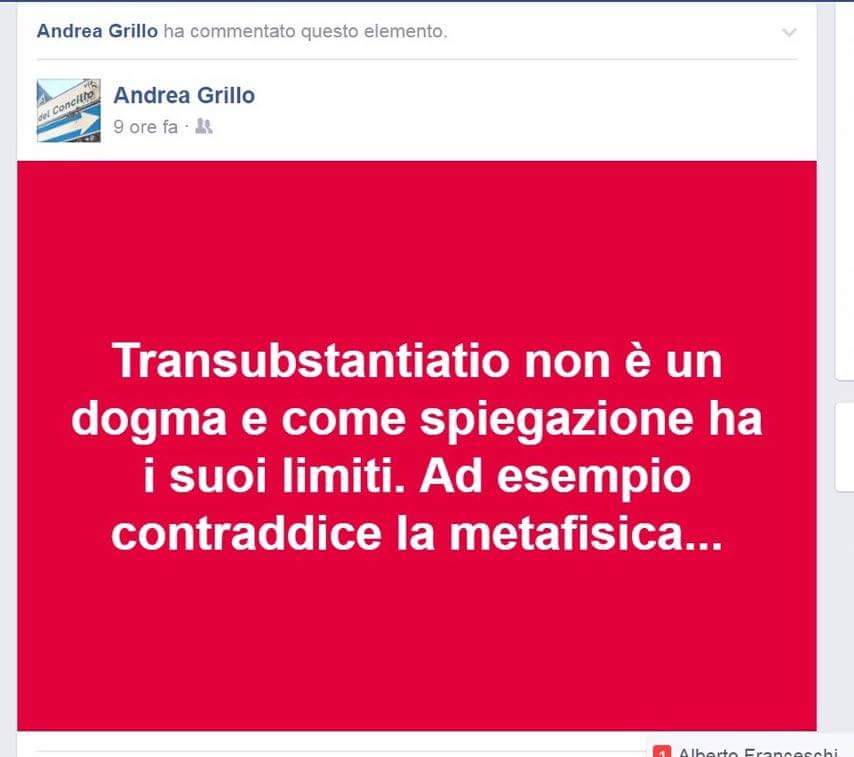
“Transubstantiation is not a dogma, and as an explanation [of the Eucharist] it has its limits. For example, it contradicts metaphysics.” [emphasis added]

I would like to understand then: have all those people who during the last two millennia have thought that in the host and in the wine [sic] there was truly the substance of the Body and Blood of Jesus – and those who still believe this now – have they been taken for a ride [by the Church]? Or, in a more benign hypothesis, were they victims of a false belief (to say nothing of Eucharistic miracles)? We are waiting with impatience to see where the work on the new ecumenical Mass will go, in order to go and put ourselves in line [for communion] at the closest Orthodox Church.

Grillo’s comments about Transubstantiation appeared on his Facebook page:

The Council of Trent, Session 13, Chapter VIII, says:

“If any one saith, that, in the sacred and holy sacrament of the Eucharist, the substance of the bread and wine remains conjointly with the body and blood of our Lord Jesus Christ, and denieth that wonderful and singular conversion of the whole substance of the bread into the Body, and of the whole substance of the wine into the Blood-the species Only of the bread and wine remaining-which conversion indeed the Catholic Church most aptly calls Transubstantiation; let him be anathema.”

I reached out to Marco Tosatti this morning, and he told me that Andrea Grillo is a layman who teaches sacramental and liturgical theology at the Pontifical Athenaeum San Anselmo in Rome. Tosatti told me that Grillo has recently attacked both Cardinals Caffarra and Sarah, “more or less asking Sarah to be dismissed from his position.” Tosatti’s sources have indicated that Grillo is a member of the secret commission to prepare this alleged “ecumenical liturgy,” which would allow Catholics and Protestants to “share the table.” Grillo is said to be influential in Rome, and to have the ear of the pope.

Grillo is also noteworthy for his opposition to Summorum Pontificum, and has written a book entitled, Beyond Pius V: Conflicting Interpretations of the Liturgical Reform, which was reviewed by the eminent liturgical theologian and author Dom Alcuin Reid, who he called it “a theological and political ‘shot across the bow’”. Reid also describes

Grillo’s fundamental stance that one must accept “the” liturgical reform absolutely and to the exclusion of all that came before (and of course, to the exclusion of any possible “reform of the reform”—which is dismissed out of hand)…

If he is indeed involved in the preparation of a new liturgy, one is left to wonder if this same attitude of liturgical evolution with no looking back will be pervasive in its implementation, too.

The Handwriting on the Wall

With no substantial confirmation of this secret liturgical commission’s existence, some will no doubt be skeptical of its plausibility. And yet there is not a little evidence that the Vatican under its current leadership might support such an effort. The pope and his associates had already been making overtures in this direction beginning in 2015, which I outlined at some length in my December, 2016 article, “Up Next on the Vatican Agenda: Intercommunion“. At the time, it had appeared that the goal was to allow Protestants to receive communion in Catholic churches. But an interfaith liturgy would take things quite a bit further, and would, it seems, be not entirely unthinkable in light of the Vatican’s own joint celebrations with the Lutheran churches marking the 500th anniversary of the Reformation, which will reach their culmination this month on October 31st — the day Martin Luther published his 95 theses in a letter to the Archbishop of Mainz in 1517. In those very celebrations, there have been hints of what might come. As I reported last December:

On October 31, 2016, following the commemoration, Cardinal Kurt Koch, president of the Pontifical Council for Promoting Christian Unity, told reporters that “it was a ‘very beautiful’ day, one that’s ‘very late’ in coming, but ‘very important.’ It’s a ‘new beginning of a way to leave conflict in the past and go toward communion in the future’”. A joint statement issued by the Vatican and Lutheran World Federation that same day said that “many members of our communities yearn to receive the Eucharist at one table, as the concrete expression of full unity. … This is the goal of our ecumenical endeavours, which we wish to advance, also by renewing our commitment to theological dialogue.” [emphasis added]

Koch has also said that “in the Second Vatican Council, Martin Luther would have ‘found his own council’”, and that “the commemoration of the Reformation in 2017 can only be made in ecumenical communion.”

For Catholics, of course, intercommunion isn’t theologically possible. Yet in Germany, we have seen evidence that this is already taking place in a very public fashion. And with the advent of Magnum Principium, it will be far easier for regional implementations of liturgical change to take root without the “imposition” of corrections from the Congregation for Divine Worship.

The question therefore of what, if any, additional liturgical surprises Rome may have in store remains an open question.

This post has been updated to include the citation from the Council of Trent. 

>>  https://onepeterfive.com/italian-liturgist-alleged-to-be-working-on-ecumenical-mass-transubstantiation-is-not-a-dogma/


>> https://abyssum.org/2017/10/28/if-this-is-not-heresy-nothing-is-heresy/


Wetenschap is juist in het christendom ontstaan

Mgr. Rob Mutsaerts heeft in de Volkskrant van 27 oktober 2017 de onderstaande bijdrage geschreven die zozeer de moeite waard is dat ik haar integraal overneem. De aanleiding is de komst naar Nederland van de de Britse beroepsatheïst Richard Dawkins die strijd tegen geloof en Kerk.

Richard Dawkins strijdt voor wetenschappelijk en rationeel denken en roept iedereen – vooral gelovigen – op toch vooral zelf te denken. Gelovigen doen dat volgens hem per definitie niet en zijn daarbij nog laf en lui ook. Toch nog maar even in herinnering roepen dat Thomas van Aquino een promotor was van Aristoteles, dat de devote priester Copernicus wiskundige en astronoom was, en een heliocentrisch model van het universum formuleerde en dat de monnik Gregor Mendel de overerving van eigenschappen bestudeerde en als zodanig een voorloper van Darwin was.

Newton, Kepler, Descartes en Pascal stonden aan de basis van de moderne wetenschap. Allen zijn devote gelovige christenen. En wat te denken van de 19de-eeuwse fysici Faraday, Maxwell en de grondlegger van de bigbang-theorie, de priester Lemaître? En van gelovige geleerden als C.S. Lewis en G.K. Chesterton?
Newton, Kepler, Descartes en Pascal stonden aan de basis van de moderne wetenschap. Allen zijn devote gelovige christenen

De moderne wetenschappen zijn ontstaan in christelijke milieus, in christelijk Europa, juist daar waar men geloof hechtte aan een door God geschapen wereld die uit haar aard voor de rede vatbaar was en derhalve de moeite waard om onderzocht te worden. Katholicisme is – anders dan Dawkins beweert – bepaald geen vijand van de wetenschap en heeft nimmer de neiging gehad zich tegenover de wetenschap te verdedigen. Het uitgangspunt van de Kerk is altijd geweest dat, juist omdat de gehele schepping voortkomt uit de ene Schepper, er geen conflict kan zijn tussen de bijbelse geopenbaarde waarheid en de waarheid die we ontdekken met ons verstand. Wat de empirische wetenschappen ook mogen ontdekken, een conflict met het geloof levert het niet op. De zogenaamde strijd tussen wetenschap en geloof is vooral een spookgevecht.

Een van de briljantste atheïsten, Bernard Shaw, gaat lijnrecht tegen Dawkins in. Shaw vond dat hij nooit het gedachtengoed van de katholieke kerk kon delen vanwege haar extreme rationalisme. Hij heeft nog gevoel voor humor ook – ‘ik ben een atheïst, en daar ben ik God dankbaar voor’ – waar ik Dawkins niet op kan betrappen. Shaw had gelijk: de katholieke kerk heeft nooit gezegd dat de rede niet de geëigende manier is om de realiteit te kennen of dat iemand het recht had wat dan ook op onredelijke wijze te benaderen.
Dawkins is aanhanger van het sciëntisme: de aanname dat realiteit zich beperkt tot wat empirisch waarneembaar is. Het succes van de natuurwetenschappen (tot uiting komend in de technologie die we dagelijks tegenkomen en die het leven op veel punten een stuk aangenamer heeft gemaakt) heeft velen ervan overtuigd dat er buiten het zichtbare en meetbare niets is – alleen fantasie, bijgeloof en primitief geloof.

Materialisten als Dawkins willen er niet bij stilstaan dat er buiten het empirische nog andere dimensies van realiteit kenbaar zijn op een niet-wetenschappelijke, maar toch rationele manier. Het zijn de blinde vlekken die het sciëntisme heeft voor literatuur, filosofie, metafysica en religie.

Geloof is geen wetenschap, maar veeleer verwant aan filosofie, poëzie en literatuur. Heeft het een esthetische dimensie? Zeker. Heeft het een literaire component? Zeker. Maar het is ook drager van waarheid. Sciëntisme, dat dit alles uitsluit, sluit de rijkdom van het menselijk kennen uit. Sciëntisme spreekt zichzelf ook tegen. Zijn bewering dat wetenschap de enige manier is om toegang te krijgen tot kennis, kun je niet empirisch vaststellen. Die bewering is filosofisch van aard. En van filosofie beweert het sciëntisme nu juist dat het geen drager van waarheid is.

Atheïsten zouden gelijk hebben als gelovigen God zouden zien als een onzichtbaar vriendje en religie een kwestie van onrealistisch wensdenken zou zijn
En dan beweert Dawkins dat het doelloze ons bestaan niet zinloos of waardeloos maakt, maar dat het een geschenk is dat we in dit toevallige heelal mogen leven. Jean-Paul Sartre en Albert Camus waren er ook van overtuigd dat God niet bestond, maar trokken daaruit wel de logische conclusie dat het bestaan leeg en zinloos is. Een atheïst kon in hun ogen niet tot een andere conclusie komen. Ze voelden een verlangen naar zin en vervulling, maar niets in deze wereld kon hun dit geven. Vandaar dat zij verklaarden dat het leven absurd is en dat vrijheid derhalve een lege huls is.

Ik ben het geenszins met Sartre en Camus eens dat God niet bestaat, maar zij volgden tenminste een heldere logica. De existentialisten zouden nooit zeggen: God bestaat niet, maar maak je niet druk, je hebt hem niet nodig.

Atheïsten zouden gelijk hebben als gelovigen God zouden zien als een onzichtbaar vriendje en religie een kwestie van onrealistisch wensdenken zou zijn. Dan zou ik ook atheïst worden. Maar onze atheïstische vrienden zitten er helemaal naast als zij menen dat het zich overgeven aan een realiteit die zich aan onze waarneming onttrekt, kinderlijk en mensonterend is. Het is een merkwaardig vooroordeel dat alleen het empirisch waarneembare voor ‘realiteit’ door kan gaan.

>>>  http://www.mennenpr.nl

Video: Doreen Irvine. De duistere kant van Halloween, en meer…

Getuigenis van Doreen Irvine
Doreen Irvine was voorheen een heks en een satanist, een prostituee, aan heroïne verslaafd, koningin van zwarte heksen in Europa, slachtoffer van gruwelijke praktijken…  maar gered door Gods kracht. Ze is christen geworden. Ze getuigt van haar geloof in God en legt de duistere zijde uit in woorden en begrippen die we begrijpen.

Video uit 1986, Nederlands ondertiteld.

Filmpje:

De ondergang van Europa.

Gerard de Boer's avatarGerard de Boer

In een toespraak tot het EU Fundamental Right Collogium in mei 2016 zei de vicevoorzitter Europese Commissie Frans Timmermans dat Brussel er alles aan moet doen om monoculturele staten uit te wissen, en het proces van omzetting naar de multiculturele diversiteit bij iedere afzonderlijke staat wereldwijd te versnellen. De toekomst van de mensheid, aldus Timmermans, zou niet langer berusten op individuele naties en culturen, maar op een gemengde supercultuur.
De massa-immigratie naar Europa zou een middel tot dit doel zijn. Geen land mag ontkomen aan de onvermijdelijke vermenging, veelmeer dienen de immigranten ertoe worden aangespoord ook de ‘verst verwijderde plekken van de planeet te bereiken om te garanderen dat er nergens meer homogene samenlevingen blijven bestaan’.

Video:

Timmermans is een van de eerste EU-leiders die zijn masker heeft laten vallen over het plan van de Europese Unie om monoculturele staten door middel van massa-immigratie uit te roeien. Mensen die vast…

View original post 168 woorden meer

Fijn, het is weer tijd voor Halloween!

karshardebol's avatarLosse flodders uit mijn hersenpan

Een paar jaar geleden ging er een schok door de wereld. De Islamitische Staat liet een filmpje zien waarin een gevangen genomen Jordaanse piloot te zien was. De piloot stond in een kooi, er liep een spoor van benzine naar de kooi. Om de kooi stonden IS strijders om toe te kijken, ze stonden op de ruïne van een oud stadion.

View original post 551 woorden meer

Bishop Schneider: Catholics must be prepared to be martyrs for their faith

October 20, 2017 (LifeSiteNews) — Catholics striving to remain in fidelity to the “greatest treasure” of their Catholic faith must be prepared for martyrdom as they witness before not only pagans and unbelievers but also other Catholics who have become heretics, said Kazakhstan Bishop Athanasius Schneider in a talk.

Schneider, Auxiliary Bishop of Astana, Kazakhstan, gave the keynote talk Thursday at The International Conference on Population Control. The online symposium was aimed at addressing the threat of population control and examining how radical enemies of life are working to undermine and subvert the Catholic Church. The event was hosted by The Lepanto Institute.

The Bishop, in his talk titled “Catholic faith and martyrdom,” told participants that Our Lord promised: “Be faithful unto death, and I will give you the crown of life” (Rev. 2:10).

“These words of Our Lord are a holy task for every Christian. To be faithful means to keep the faith, which is infused in our soul by the Triune God, in all its integrity, purity and beauty without changing nothing, without adding nothing to its unchangeable truths,” he said.

Schneider said that when a Catholic does not keep the faith, he enters into heresy.

“Heresy as infidelity to the faith … Unlike a true Catholic the heretic accepts still some dogmas, yet only on the base of his own will and his own judgment,” he said.

He said that sins against keeping the faith “are the greatest moral sins, except the sins against the Divine virtue of hope and love.”

The Bishop said faithful Catholics should not be alarmed to see that “fidelity in the Catholic faith remains usually a minority phenomenon.”

Of the minority, some might be called to martyrdom as a witness to the truth of the faith.

He quoted St. Thomas Aquinas: “Martyrs are so called as being witnesses, because by suffering in body unto death they bear witness to the truth; not indeed to any truth, but to the truth which is in accordance with godliness, and was made known to us by Christ: wherefore Christ’s martyrs are His witnesses. Now this truth is the truth of faith. Wherefore the cause of all martyrdom is the truth of faith.”

Some martyrs are called to witness to the truths of the faith before other Christians who have abandoned the faith, he said.

“The fidelity to the Catholic faith and Christian martyrdom not only demands the fearless confession of the Divine truth before the pagans and unbelievers, but even before heretical Christians,” he said.

Schneider gave the example of Sir John Burke of Brittas in Ireland, who, in the beginning of the 17th century, witnessed to the truths of the Catholic faith with his death at the hands of other Christians.

Related Schneider:

One Sunday morning in the castle of John Burke there gathered Catholics to assist the Holy Mass celebrated by a clandestine priest. However the civil authorities were informed by a traitor. Suddenly a troop of soldiers surrounded the house, where the Holy Mass had to be celebrated.

The captain asked to be admitted.

The only answer returned by Sir Burke was, that he might enter freely when if he would prepare to make his confession and urge his companions to do the like; otherwise they should remain outside, for unbelievers should not have a share in what was holy, nor should sacred things be cast to dogs or pearls set before swine.

Burke could eventually escape and flee, later however he was captured. When he was on trial in the public court, the president of the court declared that he would treat him with every kindness if he obeyed the wish of the King in all that related to faith and religion, otherwise he would sentenced to death. Yet John Burke was bold unmoved.

He then listened to the sentence of death with a cheerful countenance, and only answered that he was glad those who harmed his body in such a way had no power over his soul.

He added a few words in which he declared his aversion to heretical doctrines and opinions, and his heartfelt desire to obey the teaching of Catholic Church in whose communion he declared he wished to die. When coming to the place of execution, he asked to be set down, in order that he might approach it on his knees, and this was allowed him.

John Burke showed as much contentment and joy as if he was going to a sumptuous feast. In the last moment he was offered pardon, restitution of his lands, and preferment, if he would take the oath recognizing the supremacy of the King in religion and assist Protestant worship. He said that he would not for all the world offend God, he would not exchange heaven for earth, and that he renounced and abominated all that the Catholic Church has always repudiated and condemned. John Burke died in December of the year 1607 in Limerick.

Schneider urged Catholics to hold fast to their “greatest treasure,” the faith, “which God put in our soul in the moment of our baptism.”

“This ‘faith’ meant the integral and pure Catholic faith,” he said.

He encouraged Catholics to beg for the grace of being faithful to the Catholic faith, even unto death.

“I would like to encourage you to keep the greatest treasure you have, the Catholic faith. Keep this unchanged, pure, and ask the Lord for the greatest grace to be faithful to the Catholic faith unto death, and to be always able, and capable with all humility, to defend the faith, to confess your faith, and to defend your faith and the truth firmly and with love,” he said.

“This is my wish to all of you, to be doers of the truth and to spread this in the world so that you will be the greatest benefactors of the world,” he added.

Bron: https://www.lifesitenews.com/news/faithful-catholics-must-witness-to-heretical-catholics-even-if-it-means-mar
 

Je ziel heeft óók voeding nodig

de_wed2


De meeste mensen maken de keuze in hun leven voor kwaliteit van lichamelijk en emotioneel leven op een zo hoog mogelijk pitje. Kwaliteit van het leven voor de ziel wordt vergeten. De ziel heeft voeding nodig door de gave van Gods genade, vooral door de sacramenten gegeven tijdens Eucharistie (H. Mis) en de Biecht (zondevergeving én genezing). De meeste mensen gaan sterven zonder hun ziel verzorgd te hebben…

Als priester zeg ik dan: “Ga minstens éénmaal biechten per drie maanden en ga minstens éénmaal naar de H. Mis per week… in het weekend… Maak werk van je kwaliteit van leven in je relatie tot God. Zeg niet: God moet zich maar aan mijn wensen aanpassen. Maar: ik probeer mij aan de wil en de liefdegave van God aan te passen.

Pastoor Jack Geudens